The Domesday Duplicator (DdD) Documentation
The Domesday Duplicator was purpose built to allow high-quality back-ups of the analogue information contained on the LaserDiscs by bypassing most of the 40-year-old electronics in LaserDisc players.
The Domesday Duplicator uses direct RF capture of the FM information stored on the media and is distinguished from 'conventional capture' (such as RGB capture) which captures the signal after heavy processing which cannot be reversed or improved after the capture is made.
Since LaserDiscs are a combination of video, pictures, sound and data (as well as numerous VBI streams), direct RF sampling is the preferred method of preservation, as it is for most analog media formats in the signal domain such as videotape.
The Domesday Duplicator is a USB3-based DAQ capable of 40 million samples per second acquisition of analogue RF data.
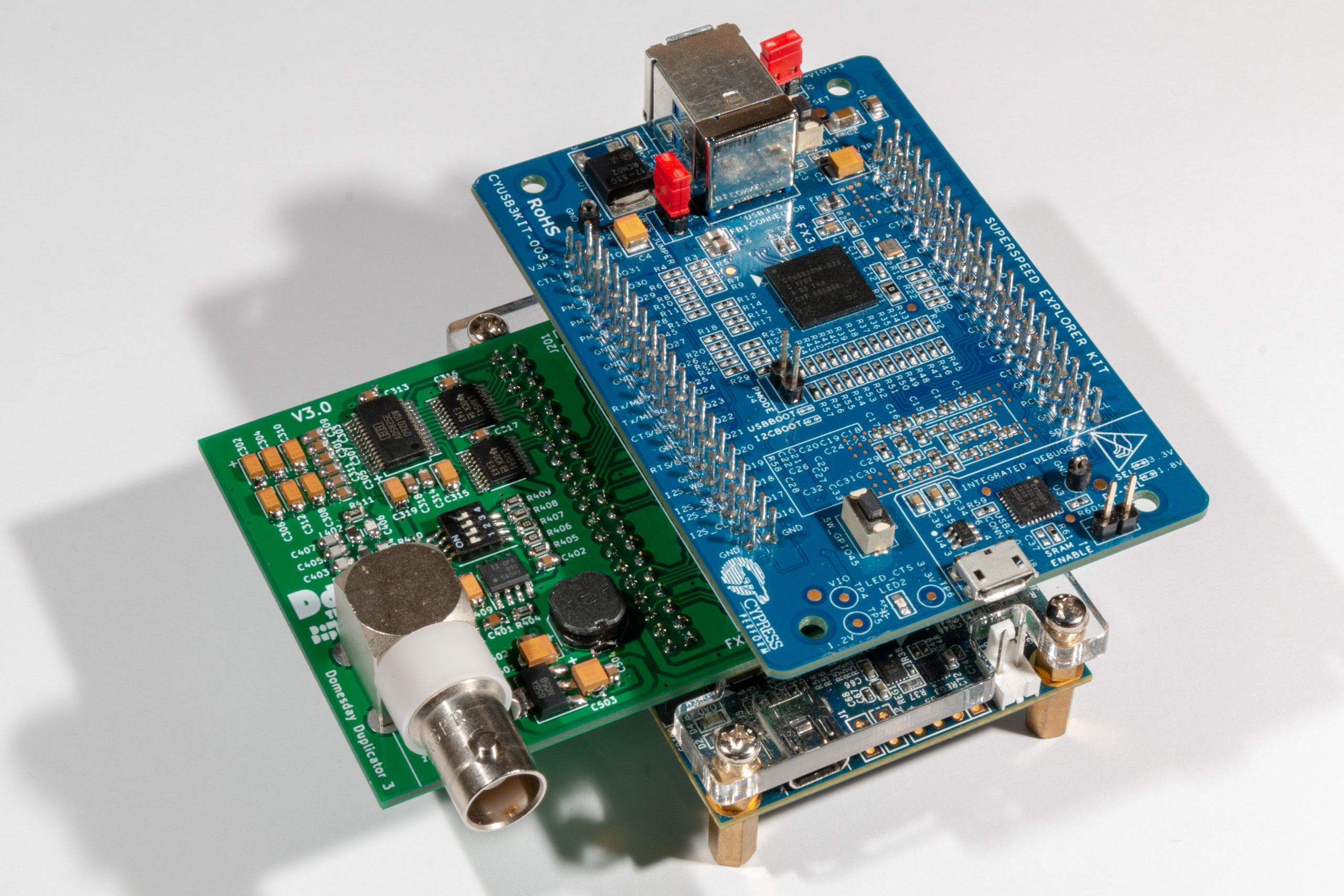
The Domesday Duplicator (DdD) Rev 3.0
The hardware is a USB 3.0 based 10-bit analogue to digital converter designed to allow the backup of Domesday AIV LaserDiscs (as well as generic LaserDiscs) through the direct sampling of the RF data from the optical head (laser) of a LaserDisc player.
The hardware/software solution is designed to act as a sampling front-end to the ld-decode (software decoder of LaserDiscs) project, which replaces the generic TV capture card to provide the entire 4fsc sampled picture frame and any data contained above its active "picture" area.
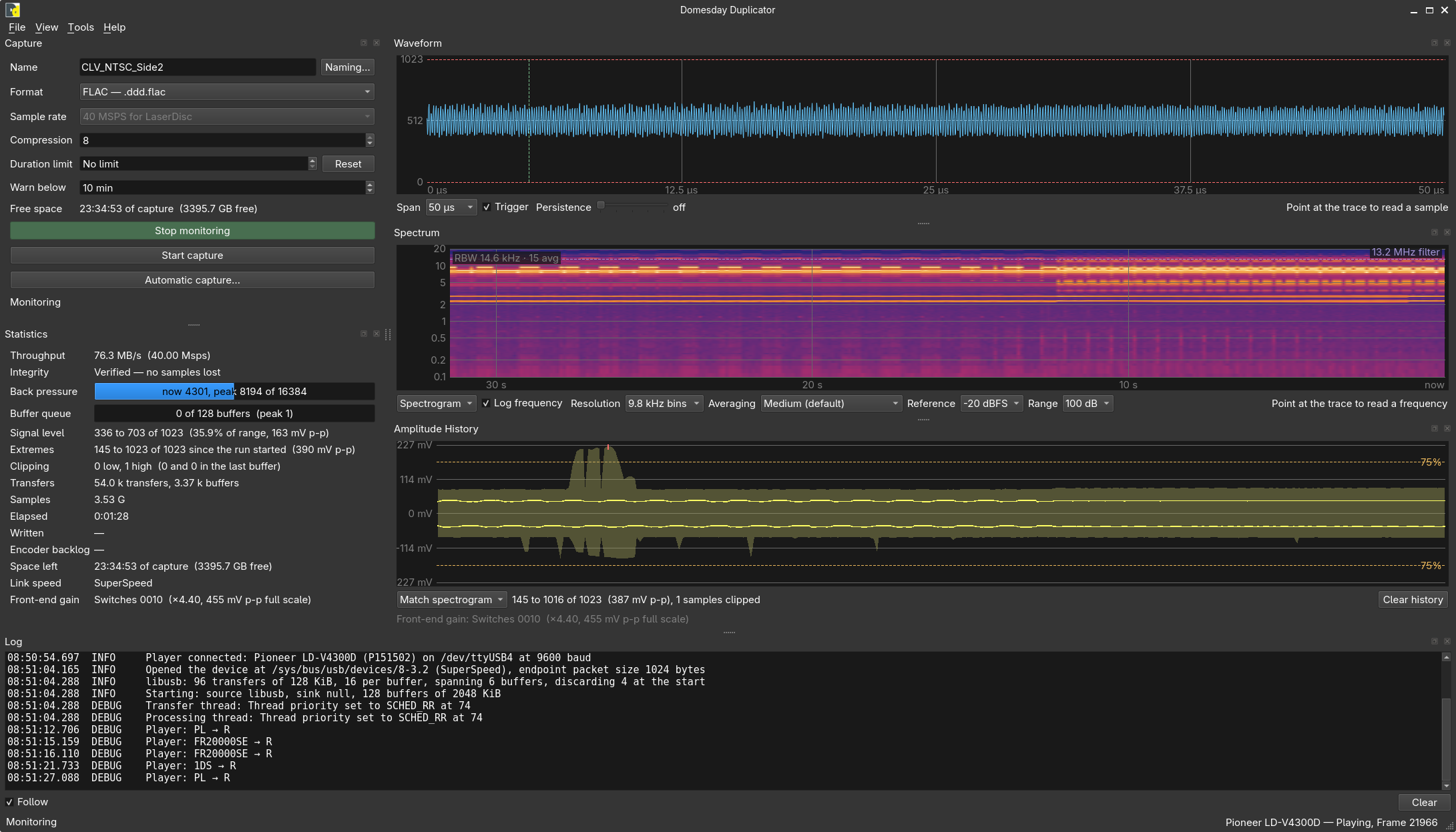
The capture application, showing the live spectrogram of the incoming RF
There are 3 main components that make up the Domesday Duplicator:
A custom ADC board based around the Texas Instruments ADS825 10-Bit, 40MSPS analogue to digital converter. This board contains an RF amplifier and conditioner (to amplify the output from the LaserDiscs player RF tap and condition it for the single-ended ADC chip) as well as headers for both the DE0-Nano FPGA development board and Cypress FX3 SuperSpeed Explorer board. RF input is physically provided by a BNC connector.
Terasic DE0-Nano FPGA development board - The DE0-Nano is a low-cost FPGA development board containing an Intel Cyclone IV FPGA. The DE0-Nano is used to process the raw 10-bit ADC data stream and provides FIFO buffering towards the FX3. The whole design runs from a single 80 MHz clock: the ADC is sampled at 40 MSPS (million samples per second, a divide-by-two of that clock) and the data is handed to the FX3 at 80 MHz — twice the rate it arrives. That headroom is what lets the USB interface catch up after an interruption, so no data is lost during sustained transfers (as RF sampling of a disc can take more than 40 minutes). Each 16-bit word carries the 10-bit sample together with a sequence number, which is what lets the capture application prove that nothing was dropped on the way.
Cypress FX3 SuperSpeed Explorer board - The FX3 is a low-cost USB3 development board from Cypress. The FX3 is used to buffer data from the FPGA and provide it to a host computer using USB3. USB3 is required for this application due to the high-data bandwidth necessary for high-speed/high-resolution sampling.