Hardware programming
A Domesday Duplicator has two programmable devices, and both must be programmed before the unit will capture anything.
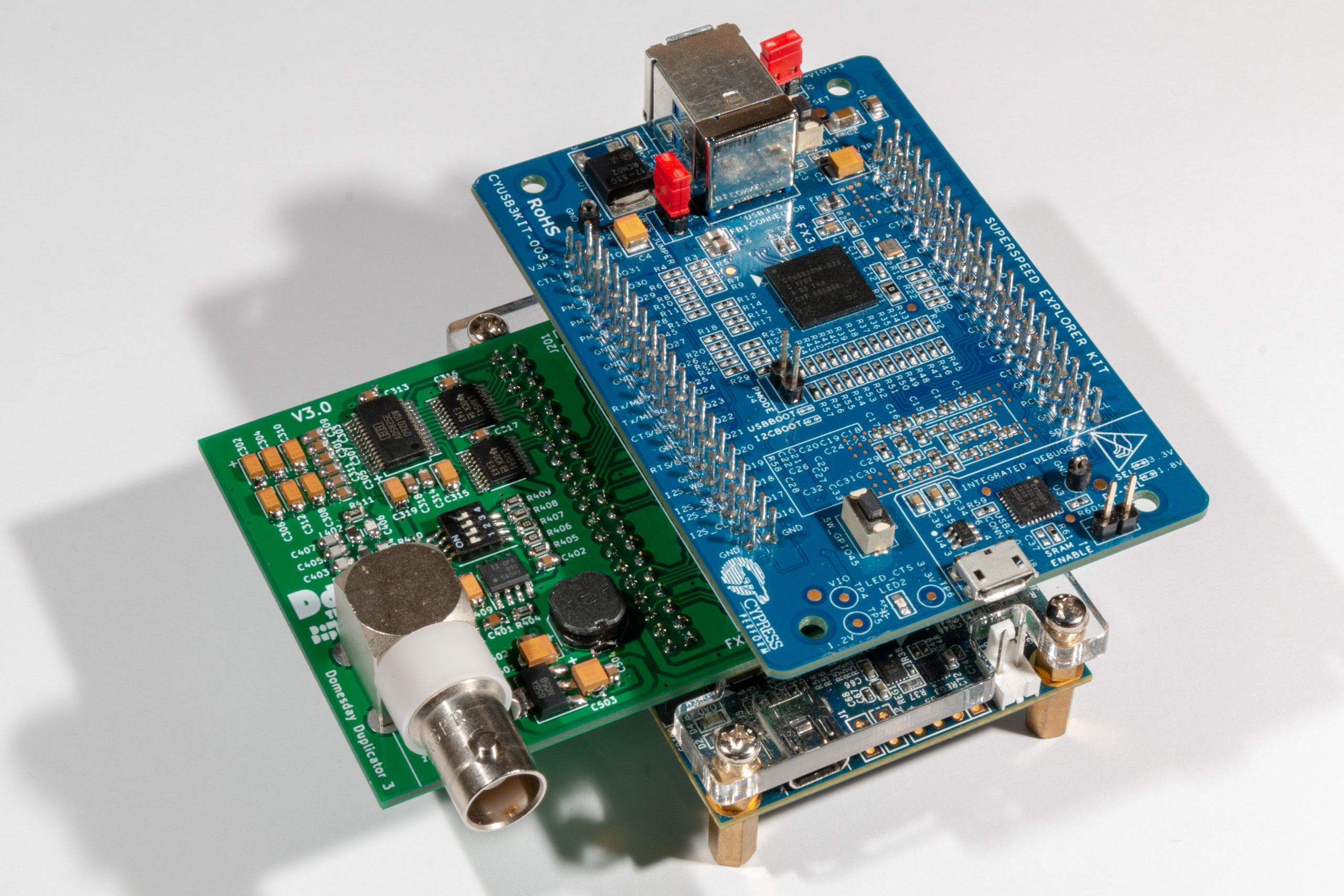 The Domesday Duplicator 3_0
| Device | Carries | Programmed with | Guide |
|---|---|---|---|
| Cypress FX3 SuperSpeed Explorer Kit | The USB 3.0 firmware that streams samples to the host | fx3-programmer over USB |
FX3 firmware |
| Terasic DE0-NANO (Cyclone IV FPGA) | The gateware that drives the ADC and the GPIF II bus | Quartus over the onboard USB-Blaster | FPGA bitstream |
Neither board is part of the Domesday Duplicator PCB itself. Both are off-the-shelf development boards that plug into it.
Which one do I need to program?
| Situation | FX3 | FPGA |
|---|---|---|
| Brand new build | Yes | Yes |
| Updating to a new release | Usually | Only if the release says so |
| Capture starts but samples are corrupt | Maybe | Maybe — the two must be in step |
| Device does not appear on USB at all | Yes | No |
The FX3 firmware and the FPGA gateware talk to each other over a parallel bus with a protocol defined in both. If you update one across a release that changed that protocol, update the other too. A mismatched pair enumerates happily and captures nothing but garbage.
Before you start, on Linux
Both the FX3 programmer and the capture application talk to the device over USB, and a USB
device is owned by root unless something says otherwise. Set that up once:
Skipping it produces confusing failures — the device is plainly visible in lsusb, but every
tool reports that it cannot find it.
Windows and macOS
Due to various restrictions around non-free tooling building and programming the hardware on non-linux platforms is not recommended nor supported.